
EiAmazonia’s environmental work is both local and Amazonian: what we do in the Juruá valley, in the Brazilian state of Acre, and what we do in schools and local areas across Catalonia.
We want to reach more schools and more regions in the rest of Spain and in Europe, because caring for the soil, the water and the forest is the same work there as here.

Recovering the land means recovering life

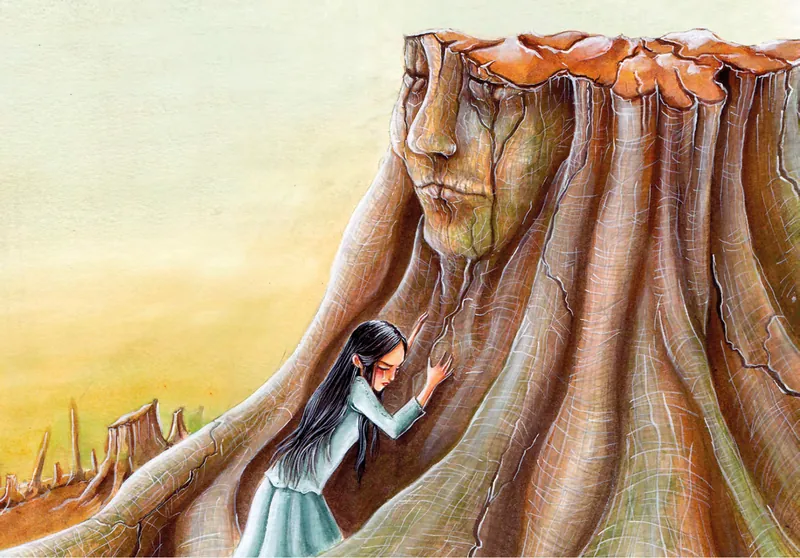
For more than a century, the peoples of the Juruá had their land taken from them and, with it, their way of cultivating it. First came the rubber bosses, who forced them to work on the seringais, the rubber estates. Then came logging and the ranches, which turned the forest into pasture for cattle.
It is the model that still dominates across much of the world: monoculture, a single species grown over vast areas —pasture, soya, sugar cane, oil palm or eucalyptus. It relies on agrochemicals: synthetic fertilisers, herbicides and pesticides that wipe out every other living thing in the field, from wild plants to insects and soil life. Brazil is now the country that uses the most pesticides in the world: 720,000 tonnes in 2021, according to the FAO.
When the forest goes, the biome disappears and, with it, the natural balance that regulated the water, the local climate and the fertility of the land. The soil is left bare, erodes and loses its organic matter. Often, within a few years, the pasture degrades and another clearing is opened in the rainforest. Across the planet, land-use change is the leading cause of biodiversity loss on land, according to the UN scientific platform on biodiversity (IPBES).
What is presented as progress enriches a few and impoverishes many. Land and profits are concentrated in a few hands: in Brazil, 1% of farms occupy almost half of all farmland. And many families lose their land, depend on seeds and agrochemicals they have to buy, or end up on the outskirts of the cities.
When a people recovers its territory, a question soon follows: how to grow the forest back and make a living from it.
One of the answers comes from Brazil and is now studied around the world: agroforestry, or syntropic agriculture. It was formulated by Ernst Götsch, a Swiss farmer who, in the 1980s, bought a degraded farm in southern Bahia and turned it into productive forest: he brought back more than ten springs, made the local microclimate milder, and today 350 hectares are a private nature reserve. The underlying idea is to plant the way the forest grows, in layers and over time, so that each harvest leaves the soil better than before.
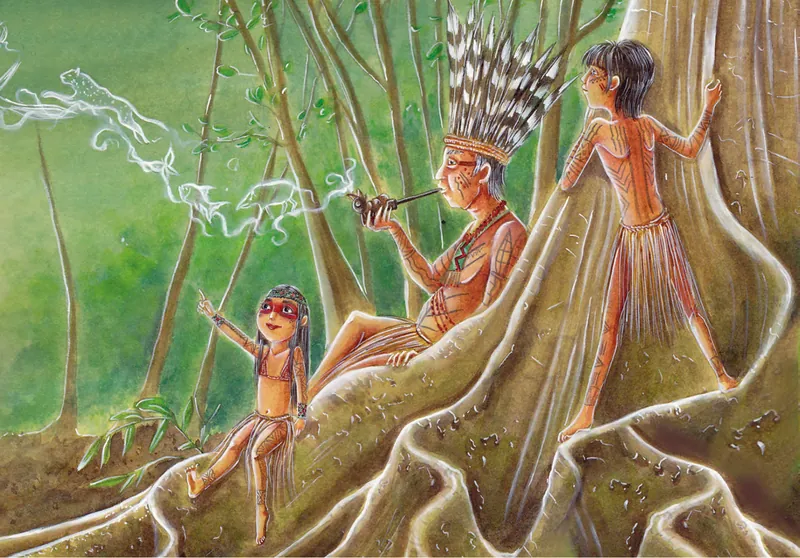
Agroforestry is the technical name for what Indigenous peoples have been doing for thousands of years.
What agroforestry is
In a conventional field, a single species is planted —maize, soya or pasture— and everything else is pulled up. In an agroforestry system, many species are planted together, at different heights and at different paces, the way a forest is organised.
The layers
A forest is organised like a building with several floors, and each floor receives its own share of light. An agroforest reproduces that structure on purpose. At the bottom, vegetables and root crops that produce food within a few months. Above them, banana, papaya and cassava. Higher up, fruit trees. And above them all, the large trees, which take decades to grow and end up forming the forest.
The species share out the light: each one occupies a different niche and they all have a function.
Time
The second dimension is time. In the same square metre, plants harvested after three months grow alongside others harvested after one year, five years and forty years. As some complete their cycle, they leave space and organic matter for the next ones. It is what happens in the forest on its own, here guided and accelerated.
That is why a well-planted agroforest provides food from the very first year, while the trees grow. And that allows a family to make a living from it.
Pruning
In an agroforest, pruning is frequent and heavy. The cut branches are chopped up and left on the ground, forming a blanket.
That blanket feeds the soil as it decomposes, retains moisture and protects the ground from sun and rain. Pruning also makes the plants grow back vigorously. In this way the system feeds itself, without fertilisers brought in from outside.
Why it is called syntropic
Conventional agriculture moves towards entropy: each harvest leaves the system a little poorer, and this has to be offset with fertilisers, irrigation and pesticides. Syntropic agriculture goes in the opposite direction: each cycle leaves more life, more organic matter, more shade, more water and more complexity than the one before. It is the direction in which the forest works on its own.
When this is sustained over time, the change can be felt beyond the plot: springs return, the temperature drops and the local microclimate becomes milder.
Knowledge of the Amazonian peoples
Amazonian peoples have managed the forest this way for thousands of years, combining crops and forest in long cycles. Much of what looks like virgin rainforest today is forest cultivated over generations: the concentrations of Brazil nut, peach palm, cacao or açaí trees are the work of those generations. Syntropic agriculture has given it a technical name, measured it and made it teachable.
That is why, when a people recovers its territory, agroforestry almost always means going back to what it already knew.
-
Monoculture
A single species. It needs synthetic fertilisers and pesticides, wipes out all other life, leaves the soil bare, loses water and becomes exhausted. When it fails, everything fails at once.
-
Agroforestry
Many species, in layers and over time. The soil always covered, water retained, shade and organic matter. Each harvest leaves the land better.
-
What is gained
Pesticide-free food all year round, fresh and varied, which improves the diet of families.
Nature is revitalised: water returns, insects and birds return, the forest returns, and with it shade and rain.
And a family can stay and live on its own land.
What we do in the communities
In the Juruá valley, the environmental work is carried out with the Indigenous schools. It starts from the Indigenous teachers’ own materials and the reality of each village, and covers waste, water, climate and care of the land.
-

Sustainability workshops at the Escola Ixubãy
In October 2025, 200 students at the Escola Ixubãy Rabuī Puyanawa took part in two workshops. In the waste workshop, the younger children drew the community’s river clean and polluted, and the older ones studied cases from Ghana, Bangladesh, the oceans and the Amazon itself.
In the climate change workshop, they worked on global warming, climate justice and the good practices of Indigenous peoples. At the end they presented their work to the whole school, with sounds of nature and Puyanawa dances.
-

Teacher training and materials
The workshops were part of the 52 hours of training followed by 22 Indigenous educators at the school, which included an environmental education module.
The teachers have created their own materials, such as the «Cartilha de Ervas Medicinais Puyanawa», on their people’s medicinal plants, and the book «Os guardiões da floresta» (The guardians of the forest).
-

The Nukini people, from 2026
The Network is extending to the Escola Estadual Rural Indígena Pedro Antônio de Oliveira, of the Nukini people, which also takes in students from the Nawa people.
The project, running from 2026 to 2027, strengthens teacher training, digital inclusion and environmental education, based on what the community decides.
All our work with schools in the Amazon · 2025 activity report
Regenerating here too
In Catalonia, in the rest of Spain and across Europe, the same thing is happening on a different scale: exhausted soils, longer droughts, fields that no longer hold water, wildfires every summer and villages emptying out. The answer that is gaining ground is regenerative agriculture, which shares its underlying idea with agroforestry: caring for the soil as a living thing.
There are people doing this very well. Hope! – En pie por el planeta, the foundation of the science communicator Javier Peña, explains climate change and regenerative agriculture on social media, with millions of views, and has CREAF on its advisory board. It is part of AgriRegenCarbon, a project that has tested, on 3,000 hectares in Andalusia and Aragon, how to pay farmers for capturing carbon in the soil and restoring ecosystems.
That is why, in the Network, environmental work is both local and Amazonian: caring for living soil in Acre and in Europe is the same work, and schools on both sides learn it together.
What we do in Catalan schools
Much of the work in the Network’s schools is environmental education, told from the perspective of the peoples who live in the forest.

-
Classroom projects lasting a term or a school year
In the schools that join the Network, the project —lasting a term or the whole school year— begins with the link to the Indigenous world, through the story «Els Puyanawa i l’Eruga de colors – Hêda Cêkaya», and from there the class works on the Amazon biome, climate change and caring for the land.
Students learn that Indigenous peoples are decisive in keeping the rainforest standing.
-
“The forest is our business too”
A workshop for schools here, from year 3 of primary to year 10: climate, waste and caring for the land, comparing the school’s surroundings with the Juruá valley. See the workshop.
And we are preparing new lines of work in this area, here and in the Amazon.
Sources
- Ernst Götsch’s Fazenda Olhos d’Água: «Da degradação à floresta: a Agricultura Sintrópica de Ernst Götsch e sua aplicação nas Fazendas Olhos D’Água e Santa Teresinha, Piraí do Norte/BA». Ambientes: Revista de Geografia e Ecologia Política.
- Cultivated forest in the Amazon: Levis, C. et al. (2017). «Persistent effects of pre-Columbian plant domestication on Amazonian forest composition». Science, 355, 925-931.
- Pesticides: FAO (2023). «Pesticides use and trade 1990–2021», FAOSTAT Analytical Brief 70.
- Biodiversity loss: IPBES (2019). Global Assessment Report on Biodiversity and Ecosystem Services.
- Land concentration: IBGE, Censo Agropecuário 2017: holdings of 1,000 hectares or more make up 1% of the total and occupy 47.6% of the area.
- Hope! and CREAF: «El CREAF entra en el comité asesor de Hope! – En pie por el planeta», CREAF blog.
- AgriRegenCarbon: «Nace el proyecto AgriRegenCarbon», project website.