Profile
- What they call themselves
- Puyanawa
- Language family
- Pano
- Population
- 745 people (Siasi/Sesai, 2014)
- Where they live
- Municipality of Mâncio Lima, state of Acre (Brazil), in the Terra Indígena Poyanawa
- Villages
- Barão e Ipiranga
- School
- Escola Estadual Indígena Ixubãy Rabuĩ Puyanawa
Population, language and land data come from the Puyanawa people profile at Povos Indígenas no Brasil, the encyclopaedia of the Instituto Socioambiental (ISA).
The history of captivity
In the late nineteenth century the rubber boom brought thousands of people into the Juruá valley. The first encounters with the Puyanawa were violent: armed expeditions entered their land to open seringais, the rubber estates where latex was tapped.
In the early twentieth century the people fell under the control of Colonel Mâncio Lima —whose name the municipality still bears— and were put to forced labour on the rubber estates. During that period they were forbidden to speak their language or hold their rituals; children were punished for using their parents’ language. It was slavery in all but name, and it lasted decades.
Hacia 1950 they freed themselves from that regime, but with no land of their own. The struggle to have their territory recognised went on through the second half of the twentieth century, until the Terra Indígena Poyanawa was officially recognised, already in this century.
Summary prepared by EiAmazonia from the Puyanawa people profile at Povos Indígenas no Brasil (Instituto Socioambiental) and from the accounts gathered with the community for the exhibition «Povo Puyanawa».
The two villages
The Terra Indígena Poyanawa lies in the municipality of Mâncio Lima, in the far west of Brazil, close to the border with Peru. It is the tip of the state of Acre, in the Juruá valley, one of the most biodiverse regions on the planet and also one of the most remote: getting there means flying to Cruzeiro do Sul and carrying on by road.
The community lives in two villages, Barão e Ipiranga, a few kilometres apart. The names come from the old seringais, the rubber estates where their grandparents were forced to work. The land that is theirs today still carries the name of those who took it from them.
The village has a school, a health post, a church, a football pitch and a community maloca : a large round building of wood and thatch where the festivals are held, the community meets and, often, classes are taught.
The festival as a school
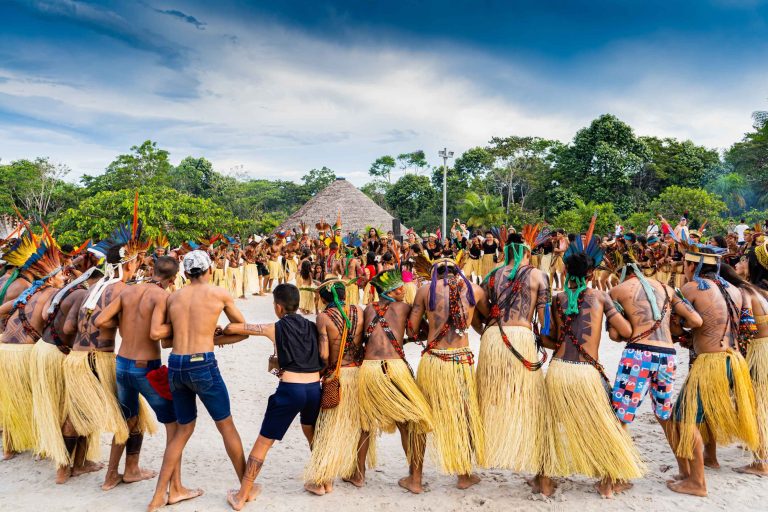
Every year the community holds its cultural festivals: whole days of singing, dancing, body painting and shared food, attended by families from both villages and visitors from other peoples. For the community it is the moment when the language, the memory and the songs are passed on to the youngest in front of everyone.
Many of those songs are the ones recorded in the village in 2016 for the album Dimãnã ewe yûbabu, the first by the Puyanawa people. It is a sound archive made by the community itself to keep what lived only in the memory of the elders.
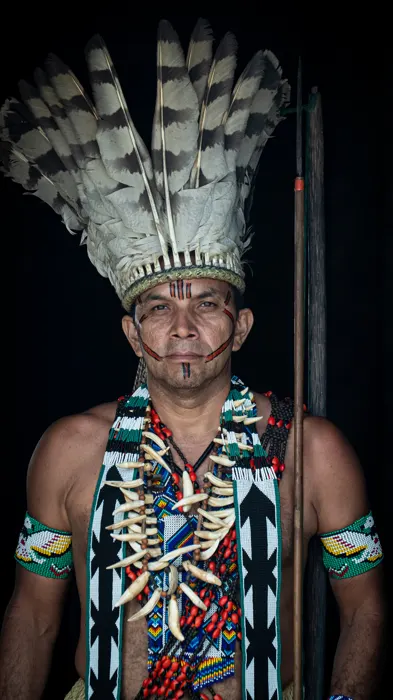
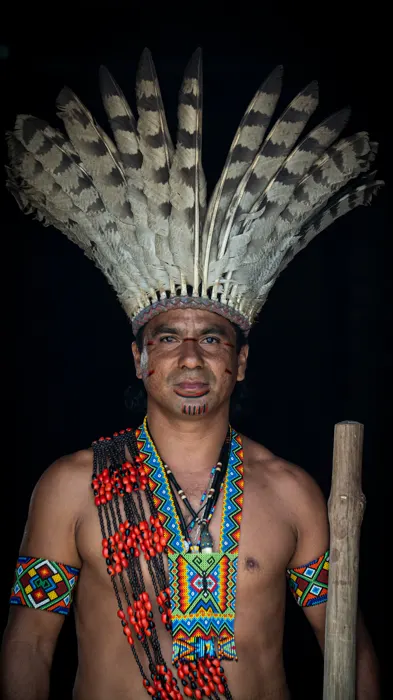
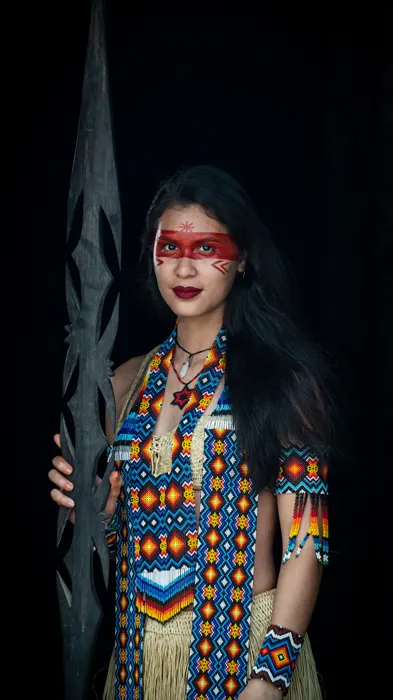
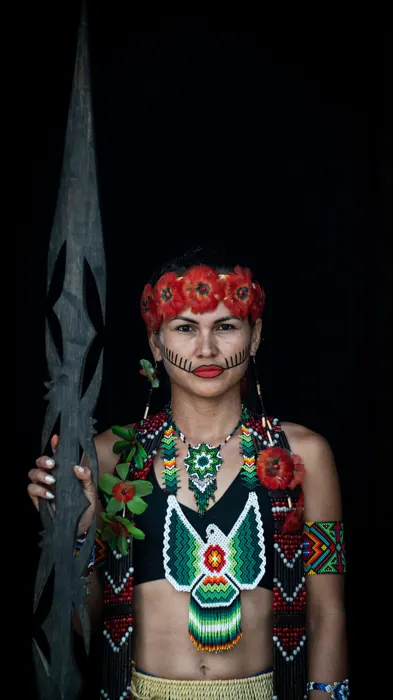
Portraits from the exhibition «Povo Puyanawa». Photographs by Blat García Vergés and Adolf Sanz Monfort; retouching by Alba Rodríguez Núñez. See the full exhibition →
The language, from ban to classroom
The Puyanawa language belongs to the Pano family, the same as several neighbouring peoples of the Juruá. Decades of prohibition left it on the edge of disappearing: for years only the elders spoke it fluently.
Bringing it back takes time: someone has to teach it, there have to be materials, the children need people to speak it with, and the community has to decide it is worth it. All of that takes years, and it is above all the work of the people themselves.
Today the recovery of the language is at the centre of the community’s school project. It is taught in class, sung at the festivals and appears in the materials the Indigenous teachers prepare themselves. The story «Els Puyanawa i l’Eruga de colors – Hêda Cêkaya» was published in Catalan and Puyanawa, and the album «Dimãnã ewe yûbabu» gathers the traditional songs recorded in the village.
Culture and life in the village
Among the features recorded in ethnographic studies are facial tattoos, crafts made with fibres and seeds, funeral rites and traditional building, such as the community maloca, which is at once a place of celebration, of meeting and of teaching.
The economy combines slash-and-burn farming for their own use —cassava, plantain, maize— with hunting, fishing, gathering and selling some produce in town.
Every year the community holds its festivals with songs, dances and body paint: that is when the language, the memory and the land are shared in front of everyone, starting with the children.
How they organise
The community has a cacique as its highest traditional authority and an association of its own, the Associação Agroextractivista Puyanawa do Barão e Ipiranga (AAPBI), which runs projects, represents the community before the authorities and has been the local partner in our projects.
The school also has its own Committee, which from 2026 becomes a direct partner of the Network: the running of things is passing more and more into the hands of the school community.
What we do together
The relationship began in 2016, with the friendship between Adolf Sanz and Puwê, and with the recording of the first Puyanawa album in the village. Out of that came the visits to Catalan schools, the story, the exhibition and, in 2017, the Network of Guardian Schools of the Amazon.
- The Escola Ixubãy Rabuĩ Puyanawa: a multimedia classroom, connectivity and teacher training.
- 2025 activity report: 22 educators in training and 200 pupils in the environmental workshops.
- Technical and financial report for the project funded by the Fons Català.
- The album, the story, the documentary and the exhibition, made with the community.
Sources
- Instituto Socioambiental, Povos Indígenas no Brasil, Puyanawa people profile (population, language, land, contact history and organisation).
- Siasi/Sesai, Brazilian Ministry of Health (population data, 2014).
- Accounts and photographs gathered with the community for the exhibition «Povo Puyanawa» and for the Network’s 2025 report.
If you spot a mistake or would like us to add something, write to us at info@eiamazonia.org.
“The Network grows with you” campaign
We are looking for 50 regular supporters this school year
A monthly contribution, however small, lets us plan the school year without depending on a grant.