Period: March 2025 – February 2026 · Puyanawa village, Mâncio Lima (Acre, Brazil)
- 13.325 €approved budget
- 13.228 €spent and documented
- 10.077 €from the Fons Català, spent in full
- 4planned activities, all four completed
What this report covers
This report covers the technical and financial delivery of the project: what was installed, how it was carried out, what results were achieved and what each budget line was spent on. It is the same content submitted to the Fons Català de Cooperació al Desenvolupament, set out here so that anyone can read it.
The educational side —what was learned, how it was worked on in the classroom, the teachers' materials— is told in the 2025 activity report, and the activities in Catalonia in the Catalonia report. The three complement one another.
Project details
- Title
- Xarxa d’Escoles Guardianes de l’Amazònia — Escola Ixubãy Rabuĩ Puyanawa 2.0, Fase 1
- Number
- 4106 (Fons Català de Cooperació al Desenvolupament)
- Where
- Escola Ixubãy Rabuĩ Puyanawa, Vila Puyanawa, Mâncio Lima (Acre, Brazil), and three schools in Catalonia
- When
- Carried out from March 2025 to February 2026. Report submitted in May 2026
- Implementing organisation
- Associació Guardians de l’Amazònia
- Local partner
- Associação Agroextractivista Puyanawa do Barão e Ipiranga (AAPBI)
- Funding
- Fons Català de Cooperació al Desenvolupament, with contributions from the town councils of Molins de Rei (8.259,30 €) y Begues (1.818,18 €)
- Sustainable Development Goals
- 3, 4, 5, 10, 13, 15 and 17 of the 2030 Agenda
Results and delivery
The project had four activities, each with its own result. All four were carried out in full.
| Activity | Result | Done |
|---|---|---|
| A1 · Shared infrastructure and connectivity | A working multimedia room with satellite connection | 100 % |
| A2 · Teacher training and support | A 52-hour programme in three modules, with follow-up | 100 % |
| A3 · Awareness raising and educational exchange | Workshops in three Catalan schools and a video call between classrooms | 100 % |
| A4 · Environmental education at the Escola Ixubãy | Workshops on waste, climate and caring for the land | 100 % |
Evidence provided: attendance records and the training timetable, photographs and documentation of the activities, records of the video calls, the teaching materials produced, and an inventory and invoices for the equipment.
What was installed
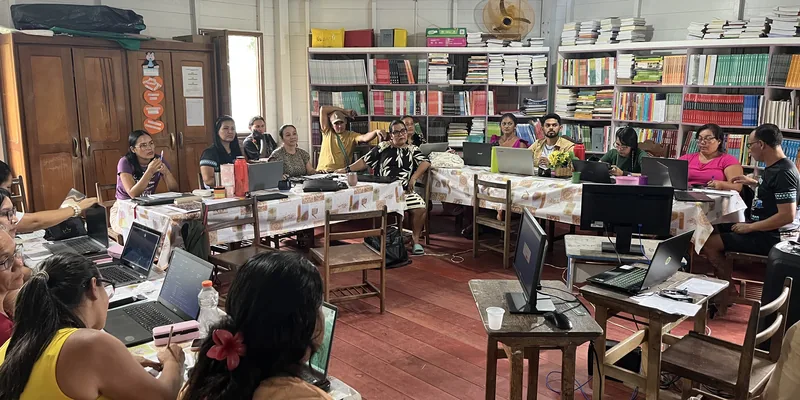
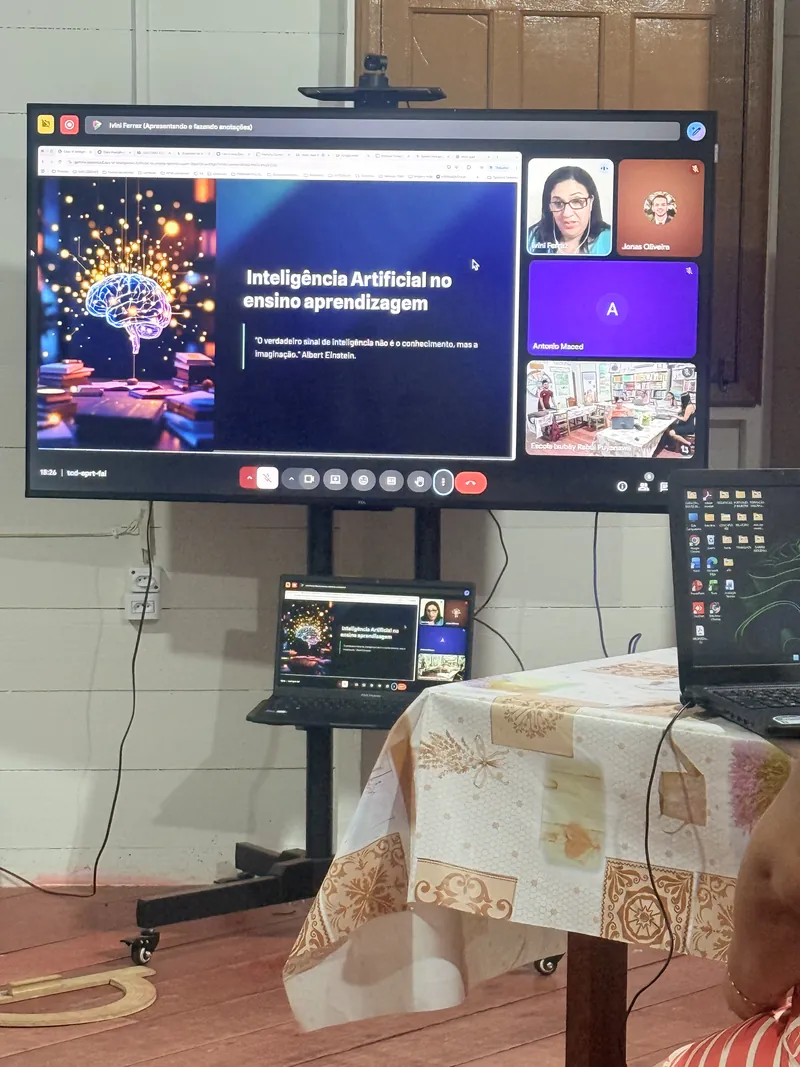
The school library was fitted out as a shared multimedia room, which is the infrastructure everything else rests on.
Building work
- Improved electrical installation and new sockets.
- Reworking of the existing wiring.
- Installation of an air conditioning unit (18,000 BTU).
Equipment
- A 55-inch large-format screen with its stand.
- Laptop, monitor and a keyboard and mouse set.
- 4K webcam, dynamic microphone and headphones.
- All-in-one printer.
- Satellite internet dish and backup battery.
The satellite connection was not an end in itself: without it, the online training, the video calls between schools and the technical follow-up of the project would not have been possible.
Who took part
| Category | Who | People |
|---|---|---|
| Rights holders | Teachers at the Escola Ixubãy and students and participants from the schools in the Amazon and in Catalonia | 337 |
| Duty bearers | School management, community governance, the local partner and the technical and teaching team | 17 |
| Obligation holders | Education authorities and funding institutions | 5 |
| Total | 359 |
- 22 Indigenous educators started the training programme; 17 completed it.
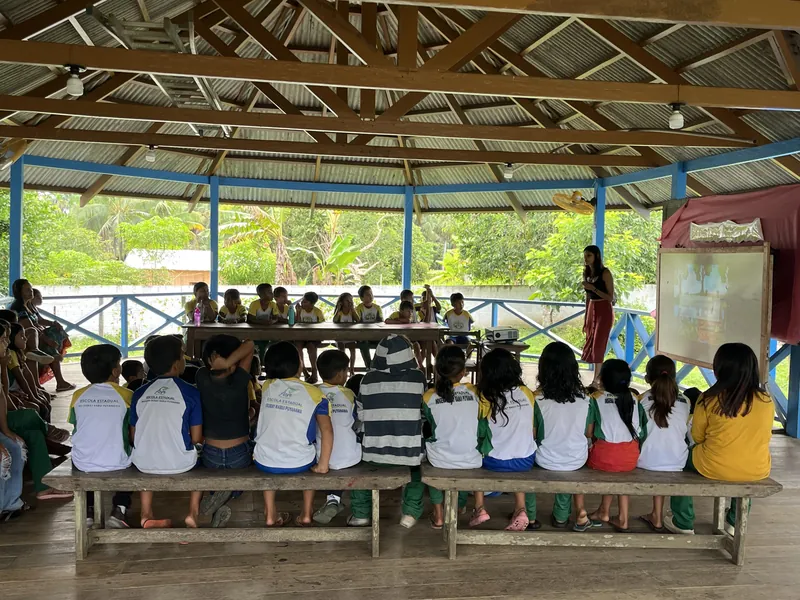
- 200 students at the Escola Ixubãy took part in the environmental workshops; 10 of them also joined the video call with Catalonia.
- In Catalonia: 25 students from the Escola El Palau, 50 from the Escola Sant Cristòfor, 20 from the Escola Castanyer, 20 people at the open session in the library and 7 teachers.
Families and the wider school communities, who took part indirectly, are not counted.
Management of funds
The project runs in Brazil, so the money travels and changes currency. This is the journey it makes, the same one we described to the Fons Català.
- There were four transfers to the local partner, totalling 9.848 €.
- Those transfers were exchanged into 61,233.69 reais, at an average exchange rate of 6.3134 reais per euro (between 6.23 and 6.48 depending on the date).
- AAPBI kept the accounts on the ground and filed the receipt for every expense.
- Bank charges, Brazilian fees and the tax on international transfers (IOF) were paid by the project itself and are counted under “Other”.
- The Fons Català checks that no type of expense goes over a set percentage. All of them stayed within the limit, and the project charged nothing for overheads.
Budget execution
These are the figures from the final report we submitted to the Fons Català. We publish what each thing cost, without the personal data of those who provided services.
| Heading | Amount | % |
|---|---|---|
| Other: grants to participating teachers, local coordination and finances, bank charges, fees and meals during the training | 4.966,10 € | 37,5 % |
| Technical and professional services: technical visits, training and satellite internet service | 3.676,83 € | 27,8 % |
| Equipment for the multimedia room | 2.427,16 € | 18,3 % |
| Outreach and awareness raising in Catalonia (own in-kind contribution) | 889,00 € | 6,7 % |
| Travel and accommodation | 689,02 € | 5,2 % |
| Use of the room provided by the local partner (in kind) | 299,36 € | 2,3 % |
| Building work: electrics and installation of the air conditioning | 280,51 € | 2,1 % |
| Total spent | 13.227,98 € | 100 % |
Approved budget: €13,324.52. The Fons Català grant was spent in full: we were given €10,077.48 and €10,077.48 were spent. The small difference in the total comes from our own contributions, not from the grant.
Sources of funding
| Source | Amount | % |
|---|---|---|
| Fons Català de Cooperació (Ajuntament de Molins de Rei, 8.259,30 € · Ajuntament de Begues, 1.818,18 €) | 10.077,48 € | 76,2 % |
| Guardians de l’Amazònia · work and activities in kind | 2.329,00 € | 17,6 % |
| Guardians de l’Amazònia · cash contribution | 522,14 € | 3,9 % |
| AAPBI · use of the room (in kind) | 299,36 € | 2,3 % |
| Total | 13.227,98 € | 100 % |
The Fons Català grant was spent in full. Part of the association's contribution is in kind: hours of work and activities that are not paid for but have a financial value recognised in the report.
Deviations from the original plan
During the project, some of the teachers received computer equipment from the Brazilian government. That led us to change priorities: instead of buying more individual devices, we strengthened what the whole school uses and the training of the teachers. Less was spent on equipment and more on technical services and training.
The video calls and the coordination with the Catalan schools needed changes of date because of the time difference, school calendars and weather conditions. Some training sessions were rescheduled to fit the teachers' availability. All planned activities took place.
Continuity
The most important step for continuity is that the Escola Ixubãy Committee joins as a partner in Phase 2: management moves further into the hands of the school community itself. The lines of work being prepared are a digital platform for Puyanawa crafts, the digitisation of language and cultural content, and the creation of their own teaching materials.
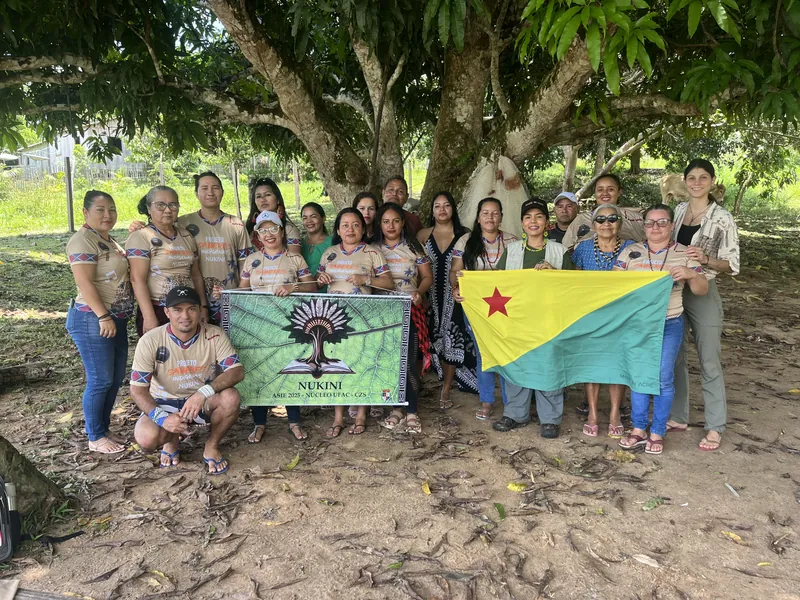
During the project we also visited the Nukini y Shanenawa communities to present the Network, and the results were shared with teachers from other Indigenous schools at the Universidade Federal do Acre (UFAC).
Transparency
This page summarises the narrative report and the final financial report submitted to the Fons Català de Cooperació al Desenvolupament. The figures come from those documents.
We do not publish invoices, suppliers' names, identity documents or the details of the people who received training grants, even though they appear in the official report.
Project coordination: Adolf Sanz Monfort. Local partner: AAPBI. Thanks to the Puyanawa community, the teaching team at the Escola Ixubãy and the participating Catalan schools.
If you need more detail about the report, write to us at info@eiamazonia.org.
“The Network grows with you” campaign
We are looking for 50 regular supporters this school year
A monthly contribution, however small, lets us plan the school year without depending on a grant.