“The Network grows with you” campaign · No closing date
Fifty people this school year. One hundred by 2028.
This year's target: 50 monthly supporters. The strategic plan's target for 2028 is 100.
The maths is simple, and we show all of it:
50 people × €15 a month ≈ €9,000 a year
€15 is the Tucano plan, the middle one of the four, and it works as a rough average. When we reach the 100 people the plan foresees for 2028, that will be around €18,000 a year. You can choose the plan that suits you.
What matters is not the exact figure, but having a monthly base we can plan the school year with: knowing that the workshops, the video calls and the support we give schools do not depend on whether a particular grant comes through. €18,000 a year can sustain a part-time coordinator, which is the first step in the association's strategic plan.
Monthly contributions do not replace voluntary work, which will remain the heart of the project: they cover what volunteering cannot (connectivity, materials, travel and steady coordination).
And we say how far this campaign goes: the 50 people this year are the first step, and the 100 in 2028 the second. For the association, the Schools Network and EiAmazonia to work properly —with coordination, communication, materials and the capacity to respond to schools— our strategic plan estimates between €39,000 and €83,000 a year, adding up supporters, grants, workshops and partnerships. This campaign does not solve everything, and we would rather say so than promise too much.
The road: 50 this year, 100 by 2028

-
10First supporters
Firm ground
With the first ten contributions we stop starting each school year from scratch and can plan the first activities without waiting for a call for grants.
-
25Supporters
Workshops and video calls
Preparing and running the workshops in Catalan schools and the intercultural video calls with the Escola Ixubãy Rabuī Puyanawa, like those we have already held with the Escola El Palau and the Escola Sant Cristòfor.
-
50Supporters
This year's target
Sustaining the training of Indigenous educators and the teaching materials they create themselves throughout the year, instead of in short bursts. It is the strategic plan's goal for this first year.
-
100By 2028
The whole Network, all year round
The Schools Network and workshops, extension to the Nukini people and steady coordination, with less dependence on grants. This is the target the strategic plan sets for 2028.
The milestones set priorities, not fixed prices: all contributions go to the project as a whole and are accounted for in our reports.
Why it is needed
The Amazon Guardian Schools Network is not an exchange of letters between distant schools. It is a learning community working at the same time in the Juruá valley and in Catalonia: Indigenous schools that teach in their own language and defend their land, and schools here that learn with them. In ten years we have trained Indigenous teachers, brought connectivity and equipment to Amazonian classrooms, sat children from two continents down to talk face to face and reached more than 2,000 students in Catalonia. In 2025 alone, 22 educators and 200 students at the Escola Ixubãy Rabuī Puyanawa.
And all of this is held up by voluntary work and by grants that have to be applied for again every year. Since 2016 we have grown through calls for proposals: each project is submitted, you wait for the decision and, if it comes, you carry it out within a few set months.
That model has made valuable things possible, but it has a clear limit: what is continuous —supporting a group of teachers, preparing a workshop, keeping up a video call between two schools 8,000 km apart— does not fit into a grant calendar. When a project ends, the relationship is still there, but the means to look after it are not.
We have got this far with grants from the Fons Català de Cooperació al Desenvolupament and from town councils such as Molins de Rei, Begues and Sant Feliu de Llobregat, with one-off donations —including those from students who raised funds themselves— and with contributions from the founders. And, above all, with a great deal of voluntary work: the team, the board, the teachers in Catalonia and in the Amazon, and the people who help from home. Everything you see on this website exists thanks to them.
What gets paid and what does not. When a project is funded, it pays what that project allows: the workshops, the training, the technical services. What almost never has funding is the work that keeps the organisation standing: coordinating, writing and reporting on projects, communicating, preparing materials, answering schools and running the learning platform. That is hundreds of hours a year, done today on a voluntary basis, with very few people available.
We do not say this as a complaint, but as what it is: the association's main risk. It is written that way in our Economic Sustainability Strategic Plan 2026-2029, which points to the dependence on voluntary work for continuous tasks and proposes a clear way out: professionalising the organisation step by step, starting by paying for coordination. We are not after a large structure, but a minimal, stable and transparent one that keeps going what already works.
A base of people giving every month is what makes it possible: it is small, it is predictable and it is ours. That is why we are asking for help to get it started.
-
Indigenous education in Brazil
Since 1988 Brazilian law has recognised a distinct Indigenous school, bilingual and intercultural. In practice, most of those schools have no internet connection, many only go up to the first years —to carry on studying you have to leave the village— and much of the Indigenous teaching staff works on temporary contracts, with low pay and late payments: they teach in their own language and in their own community, but without the job security or the salary the rest of the profession has.
Brazilian School Census (INEP)
-
Internet arriving all at once
In a very short time, satellite dishes have brought the internet to villages that had never had coverage. It brings good things —reporting an emergency, denouncing an invasion, studying remotely— and also problems no one prepared for: children exposed to content they should not see, hours glued to social media, scams, and less time for the language, collective work and community life.
That is why our work is not about delivering devices: it is about supporting schools so that they decide how to use them.
Critical digital literacy · Reports on the arrival of satellite internet in the Amazon (2023-2024)
-
Climate justice
The Amazon has already lost close to a fifth of its forest, and scientists warn that there is not much margin left before a change with no way back. Indigenous territories are, by far, the best preserved. Those who have contributed least to climate change are the first to suffer it.
MapBiomas · RAISG · IPCC
-
Global citizenship
A class in Catalonia and a school on the Juruá river learn together, write to each other and meet live. It is not one side helping the other: it is an exchange. Out of it come students who understand that what happens in the Amazon is happening to them too.
SDG target 4.7 · Education for global citizenship
Where your contribution goes
-
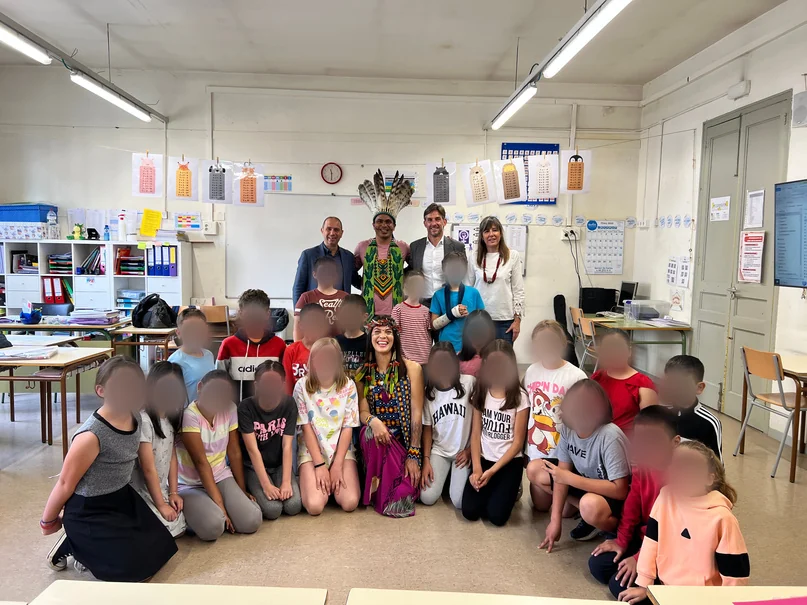
1 · The Schools Network and workshops
Keeping going what already works
Workshops in schools, teaching materials, exchanges and video calls between students in Catalonia and in the Amazon.
- In Catalonia, 2024-2026: 12 activities, 4 schools, 140 children taking part directly and more than 180 families reached.
- Since 2016: 9 Catalan schools and more than 2,000 students (más de 800 in direct activities and more than 1,200 at open events).
- In the Amazon, 2025: 52 hours of training en 3 modules para 22 educators at the Escola Ixubãy Rabuī Puyanawa, with 200 students benefiting indirectly.
-
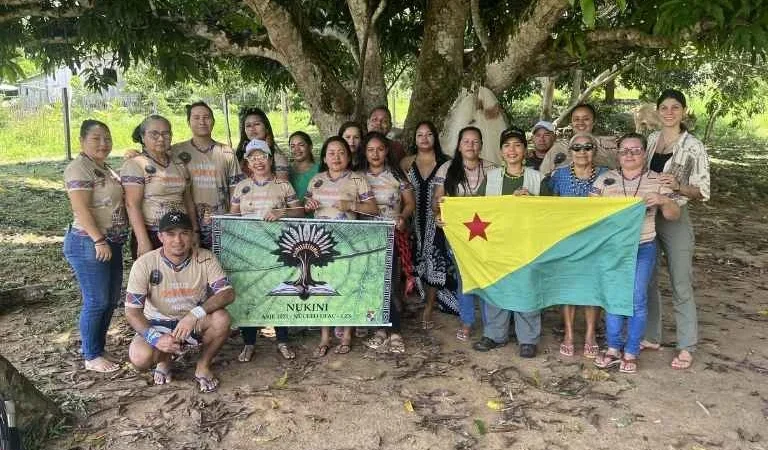
2 · Extension to the Nukini people
A second community, in 2026
The experience of the pilot project with the Puyanawa people is being extended to the Escola Estadual Rural Indígena Pedro Antônio de Oliveira, in the Nukini community, always following the priorities each community sets.
- First meetings and training with Nukini teachers already held.
- In parallel, phase 2 at the Puyanawa school: mentoring for 3 projects led by Indigenous teachers (a dictionary of the Puyanawa language, a digital library of Indigenous materials and a third project from group 3).
- After phase 1, 70% of the educators now have basic digital inclusion and access to essential services such as the gov.br portal.
-
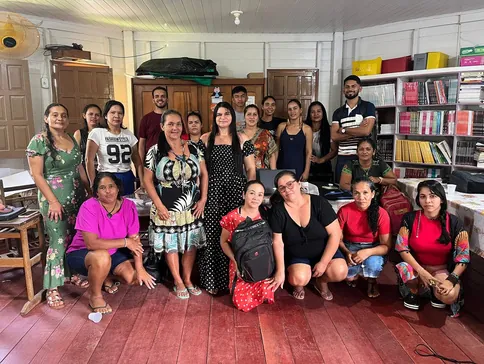
3 · Structure and continuity
Coordination, team and administration
The least glamorous and most necessary part: someone to coordinate, prepare the sessions, answer the schools, maintain the learning platform and account for it all.
- Coordinating work between Catalonia and Acre, six hours apart and with an intermittent connection.
- Connectivity, materials and travel: exactly what voluntary work cannot cover, however much goodwill there is.
- Less dependence on public grants and more freedom to decide together with the communities, without waiting for a call for proposals.
What changes if we reach 50
That we can say yes when a school writes to us in November and not in the month the project happened to cover. That a group of Indigenous teachers who have learned to run video calls can keep running them the following year. That the material the teachers themselves prepare gets printed and reaches the classrooms.
It also means being able to plan with the communities two or three years ahead instead of going from one grant call to the next, and being able to approach institutions and companies with a base of our own behind us.
We do not promise more than we can deliver: we are not going to build schools or fix the situation of the Amazon. What we do is more modest and very specific: supporting a group of schools, in two territories, steadily and telling the whole story.
Where we are heading
We are finalising partnerships with Indigenous organisations in Acre (Brazil) so that we can extend the work next year and take our projects to other peoples of the Juruá valley, beyond the Puyanawa and the Nukini. Every extension is decided with the communities and at their pace: first the agreement, then the project.
At the same time we are applying for registration with the Catalan Agency for Development Cooperation and the Spanish Agency for International Development Cooperation. That recognition would open the door to public cooperation grants we cannot apply for today.
We also want to apply for public benefit status, the official recognition given to associations of general interest that have been running for years and account for themselves transparently. It is a long road with demanding requirements —years of activity, up-to-date accounts and financial reports— and that is why we say it as it is: a goal, not something already achieved. If it were ever granted, contributions would become tax deductible in Spain; until then, they are not.
Both of these need the same thing: a steady base of supporters. To sign agreements and apply for grants you have to show continuity, be able to travel, follow the processes through and meet the commitments you take on. That is exactly what monthly contributions make possible.
Choose your monthly contribution
-
Plan Colibri
€5 a month
€60 a year. A small contribution that, multiplied, turns what is intermittent today into something steady.
Join the Colibri plan (€5 a month) -
Plan Tucano
€15 a month
€180 a year. This is the average the target of this campaign is based on.
Join the Tucano plan (€15 a month) -
Plan Guacamayo
€25 a month
€300 a year. Roughly what almost two people on the Tucano plan would give.
Join the Guacamayo plan (€25 a month) -

Plan Jaguar
€50 a month
€600 a year. The contribution of someone who wants to sustain a large part of the school year.
Join the Jaguar plan (€50 a month)
Payment is made by card through HubSpot's secure gateway and you can cancel whenever you like by writing to info@eiamazonia.org. You will receive a receipt by email with every payment. The association does not have public benefit status, so these contributions are not tax deductible: we would rather say so plainly.
Prefer a one-off donation?
You can also make a single gift, with no monthly commitment. It helps just as much, although it does not give the predictability this campaign is looking for.
Card donations (Stripe) open in a separate window and PayPal completes the donation in its own window: neither of them allows their payment to be fully embedded in other websites.
Other ways to join in
If you cannot give, share. Whether this campaign reaches a hundred people depends above all on those who already know us telling others. The text is ready: you only have to choose where.
-
Your school
Primary and secondary schools can join the Network: workshops, materials, video calls and exchanges with Amazonian Indigenous schools.
Link a school -
Your time
Education, communication, translation, design or technology: volunteering is, as things stand, what holds the project up.
Volunteer -
Your organisation or company
Town councils, organisations and companies can support the Network with long-term partnerships and help us diversify our funding.
Frequently asked questions
How is the monthly contribution collected?
By card, automatically each month, through HubSpot's payment gateway (which uses Stripe). The payment is made on their secure page: we never see or store your card number.
The payment page is shown in your browser's language. The first payment is taken when you sign up and, from then on, once a month.
Can I cancel or change plan whenever I want?
Yes. Write to info@eiamazonia.org and we will cancel your contribution or move it to another plan. No explanations, no notice periods and no penalties.
You can also write to us if you want to pause it for a while.
What receipt do I get? Is it tax deductible?
You will receive a receipt by email with every payment and, for monthly contributions, an invoice in PDF.
The Associació Guardians de l’Amazònia does not have public benefit status, so contributions are not tax deductible in the Spanish tax return. We would rather say so clearly before you join, not afterwards.
We do intend to apply for that public benefit status later on. If it were granted, we would tell all our supporters and from that moment their contributions would indeed be deductible.
Where exactly does the money go?
To three things, in this order:
- The Schools Network and workshops: workshops in schools, materials, exchanges and video calls between Catalonia and the Amazon.
- Extension to the Nukini people, planned for 2026, and continuity of the work with the Puyanawa school.
- Structure and continuity: coordination, team, connectivity, travel and administration.
There are no fixed percentages per heading: contributions go to the project as a whole and are accounted for in our reports.
How do I know it is well spent?
We publish what we do and what we spend. On this website you can read the 2025 activity report (pilot project with the Puyanawa people) and the Catalonia report 2024-2026, as well as the financial reports of each project (album, storybook, documentary and exhibition), with the figures and the funding sources.
We are also preparing a financial report for the association, which will be published under Memorias.
What if I cannot give money?
Sharing the campaign genuinely helps, and it is free. You can also volunteer with us, link your school to the Network, or put us in touch with an organisation o una company that could support the project.
When does the campaign end?
It has no closing date. This year's target is 50 people and the 2028 one is 100; the counter on this page will keep being updated. Each time we reach a target we will say so and explain what comes next.
Transparency
Who we are, why we exist and what we have done with every euro: it is all published and you can read it before deciding.
The Associació Guardians de l’Amazònia (tax ID G66796475, registration no. 58971) has its registered office at Carrer Garrigues, 11 – 08859 Begues (Barcelona), and is the organisation behind the EiAmazonia educational platform.