Workshops for schools

The workshops of the Amazon Guardian Schools Network bring students closer to the Amazon as a living territory and to Indigenous peoples as peoples of today, with their own language, school, memory and knowledge. They take place at the school itself and can be run on their own or as part of a classroom project.
This catalogue will keep growing. We will add new workshops and activities as they are ready. If you are looking for something specific for your school, write to us and we will look at it together.
-
Primary · years 3 and 4
«Els Puyanawa i l’Eruga de colors – Hêda Cêkaya»: the Amazon, nature and Indigenous peoples
A hands-on workshop based on the storybook of the same name.
- ForYears 3 and 4 of primary school
- Length1 h 30 min
- FormatHands-on workshop in the classroom
- AreasInterculturality · Nature · Eco-social education
The workshop combines a sensory opening —a short meditation with forest sounds— with the telling of the story, a brief presentation of the Amazon Guardian Schools Network, Amazonian materials and crafts, a participatory activity and a closing moment with Puyanawa song or dance.
The activity brings students closer to the Amazon as a living territory and to Indigenous peoples as peoples of today, with their own language, school, memory, knowledge and ways of relating to nature.
The workshop at the Escola Sant Cristòfor in Begues. Overall aim
To bring students closer to the reality of Amazonian Indigenous peoples and their relationship with nature, working on interculturality, care for ecosystems and the idea that we are all part of the same web of life.
Key ideas
- The Puyanawa are a living Indigenous people of the Amazon, with their own history, language, school and community.
- The forest, the rivers, the animals, the plants and people are all part of an interdependent web of life.
- Caring for nature is not only protecting it: it also means walking through it, listening to it, respecting it and feeling part of it.
- The ecosystems near the school also help us find calm, wellbeing and connection with life.
- Many Indigenous communities offer inspiring examples of a respectful, balanced relationship with the land, without idealising or copying their way of life.
How it works
-
Finding ourselves on the map
The activity begins by locating Catalonia, Brazil and the Amazon.
-
Sensory opening
Students close their eyes for a few minutes and listen to forest sounds to set the scene.
-
The story
«Els Puyanawa i l’Eruga de colors – Hêda Cêkaya» is told, highlighting the caterpillar's message: life is connected, and what happens in one part of the web affects all the rest.
-
Who we are: materials and crafts
A short presentation about Guardians de l’Amazònia and the Amazon Guardian Schools Network is shown. The materials and crafts are presented as cultural objects with value and meaning.
-
Activity: “The circle that connects us”
Cards are handed out with elements of the web of life: water, river, tree, seed, bird, insect, soil, rain, child, mother, grandparent, school, language, community, mountain, neighbourhood or park. The group stands in a circle and each child introduces their element with a simple sentence: “I am the water and I help…”, “I am the tree and I give…”.
From there, the facilitator suggests connections through movement: those who need water take a step forward; those who depend on trees raise their card; those who help look after the neighbourhood gather in the middle. To make it more visual, a piece of string can be used to link some of the elements, although the activity also works with just the cards, the body and words.
-
Back to our own surroundings
“Which place in our town helps us breathe better, walk calmly or feel part of nature?” In this way the activity goes beyond the idea of conservation and becomes an experience of belonging, wellbeing and responsibility.
-
Closing: traditional Puyanawa dance
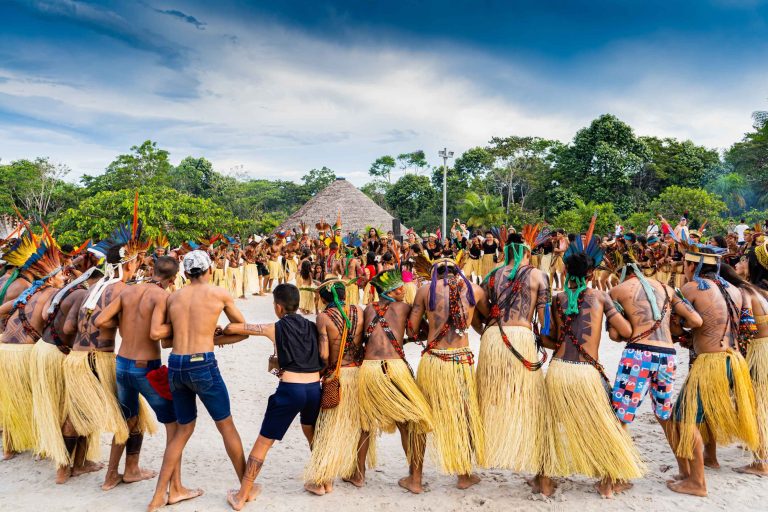
The workshop ends with a traditional Puyanawa dance, as an expression of community, memory and connection with nature. Students take part simply and respectfully, experiencing the rhythm and movement as a shared way of closing the session.
The original outline does not break the time down between the different stages: it gives a total length of 1 hour 30 minutes.
Connection with the school's surroundings
The workshop links the message of the story to natural spaces in the school's own town. The original outline was prepared for Sant Boi de Llobregat, where the sites used are the Sant Ramon hill and the Montbaig forest park, the Vall de Santa Bàrbara, the Can Soler stream, the Anell Verd, the river Llobregat, the Baix Llobregat agricultural park and the wetlands of the Llobregat delta.
The local connection is built through experience: walking through these places, observing animals and plants, listening to the sounds, breathing calmly and feeling that these ecosystems also look after us and help us settle.
What we bring
- The storybook, a slide presentation and audio with forest sounds.
- Amazonian materials and crafts.
- Cards with the roles for the activity.
- Optional: string to show the connections.
What the school needs to provide
- A projector or screen.
- Speakers.
- Space to form a circle.
Expected outcome
Students finish the workshop with an experience that connects the Amazon to their own surroundings. The aim is to awaken curiosity, intercultural respect and a more sensitive relationship with nature: not only as something to be conserved, but as a web of life we are part of and depend on.
In some cases the workshop is free for the school (when a town council or organisation funds it); otherwise, please ask us.
-
Primary · years 5 and 6
Interculturality, stereotypes and living together. «Cultura, qui ets? i els Guardians de l’Amazònia»
How can we get to know different cultures and people without reducing them to stereotypes or spreading rumours?
We cooperate · We question · We talk · We clarify · We communicate
- ForYears 5 and 6 of primary school
- Length3 sessions and a final audio piece
- FormatLearning unit
- ApproachCooperative work · Structured debate · Card game · Audio piece
A learning unit that explores interculturality starting from what students already know: objects, words, images and contexts. They discover, question, talk, clarify and finally communicate.
The three sessions
-
Discover and question
- We explore the culture capsule: objects, words, images and contexts.
- We tell apart what we observe, what we know and what we interpret.
Materials: the culture box. The idea guiding the session: objects, uses and contexts.
-
Talking in order to live together
- We prepare a debate on interculturality.
- We listen to arguments and review our ideas.
- We avoid talking about groups as if everyone in them were the same.
Materials: cards on exchange, identity, shared culture y living together, and a self-assessment of the debate with three criteria: arguments, listening and respect. The idea guiding the session: arguing and listening.
-
Clearing up rumours
- The facilitator reads out a rumour.
- The “guardians” ask questions and check the facts.
- The mediator adds further information.
Materials: question cards and evidence cards, with prompts such as “What features does it have?”, “What evidence do we have?”, “What other explanations are possible?” and “What are we taking for granted?”. The idea guiding the session: we know → we interpret → we assume.
The original poster does not state the length of each session.
Final product: the audio piece «Cultura, qui ets?»
An audio piece created by the students to encourage empathetic, respectful and inclusive coexistence.
What we learn
- Discover
- Question
- Talk
- Clarify
- Communicate
Every person is unique because of their differences and their personality. Cultural and linguistic diversity is a richness.
In some cases the workshop is free for the school (when a town council or organisation funds it); otherwise, please ask us.
-
Secondary · years 9 and 10
The Amazon, technology and global citizenship
Small actions, big connections.
We learn · We talk · We create · We change things
- ForYears 9 and 10
- Length3 sessions of 1.5 hours
- FormatLearning unit y community service
- ApproachGroup work · Exchange with the Nukini community · Real outputs for the school community
A learning unit and community service project for years 9 and 10, designed to connect realities, build knowledge and take action locally: global justice through local action.
The three sessions
-
Learn and prepare
1.5 hours
- We discover the Amazon and the Nukini people.
- We reflect on human rights, climate justice, consumption and technology.
- We look at how we use technology and the challenges and opportunities it brings.
- We form three working groups and prepare questions for the exchange.
-
Talk and develop
1.5 hours
- We exchange with the Nukini community (video call, or videos and messages).
- We share experiences, questions and points of view about the land, school, technology and global challenges.
- We work in groups with what we have learned and start developing our outputs.
-
Create and share
1.5 hours
- We finish each group's output.
- We present them to the class and to the school community.
- We share the results with the Nukini community.
- We close with a reflection on what we have learned and how we can keep acting.
The working groups
Three perspectives, one shared commitment.
-
Group 1
Ten principles for responsible technology
We draw up ten recommendations together with young people from the Nukini community for a responsible, ethical and intercultural use of technology.
- Privacy and personal data
- Consent and images
- Critical use of social media and AI
- Cultural respect
- Environmental impact, among others
-
Group 2
A collection of free, useful digital tools
We create a short guide to digital tools that help us learn, communicate and work together.
- Tools for presentations, video, design…
- Working together
- Translation and accessibility
- Artificial intelligence
- Free and easy-to-use tools
-
Group 3
Spreading the word about XEGA
We design a communication piece explaining what the Amazon Guardian Schools Network (XEGA) is and what the exchange between schools in Catalonia and Amazonian Indigenous communities brings.
- Video, infographic, poster or audio piece
- Clear messages, free of stereotypes
- In young people's own words
Final product
A kit created by the students for the whole school community, made up of the ten principles for responsible technology, the collection of free digital tools and the piece about XEGA.
Why it matters
- We connect local and global realities.
- We encourage critical, committed citizenship.
- We contribute to a fairer, more sustainable future.
A living Amazon · Schools that connect · Young people who act
What the school gains
This is designed as a learning unit and community service for years 9 and 10, and it leaves the school with real outputs created by students for the whole school community.
In some cases the workshop is free for the school (when a town council or organisation funds it); otherwise, please ask us.
-
Primary (years 3 to 6) and secondary
The forest is our business too: climate, waste and caring for the land
What we do here is felt there, and what happens there reaches us here.
We observe · We measure · We compare · We act
- ForFrom year 3 of primary to year 10 (adapted to each age)
- LengthOne session of 1 hour 30 minutes, or three sessions if run as a project
- FormatClassroom workshop, with the option of a visit to the local area
- ApproachGroup work · Materials made by Indigenous teachers · Comparison between the school's area and the Amazon
Environmental education with a difference: we do not talk about the Amazon as a distant documentary, but through what the Indigenous schools we work with tell and teach. Students compare their own surroundings with the Juruá valley and discover that the two are linked by climate, by water and by what we consume.
What we work on
- Climate and the greenhouse effect, explained with examples you can see and touch.
- Waste and consumption: where things come from and where they go when we throw them away.
- Water, forest and biodiversity: why the rainforest regulates rainfall far beyond its own borders.
- What we can do at school, at home and in the town, without falling into “it makes no difference”.
How it works
Looking at our own surroundings
- What we have nearby: trees, water, waste, energy.
- What would change if it disappeared.
Looking at the Juruá
- How people live, what they care for and what threatens them in the Puyanawa and Nukini communities.
- Materials made by the Indigenous teachers themselves.
Taking action
- The group chooses one concrete, realistic action for the school or the town.
- They agree how to check whether it works.
Expected outcome
A small, checkable commitment for the school year, and the awareness that caring for the land is not something for other countries: it starts in the school playground.
In some cases the workshop is free for the school (when a town council or organisation funds it); otherwise, please ask us.
-
Young people and families · years 5 to 10
Screens with judgement: young people and families facing devices and social media
It is not about banning, but about deciding.
We listen · We understand · We decide · We agree
- ForStudents from years 5 to 10, and their families
- LengthOne session with the students and a talk-workshop with families (1 hour 30 minutes each)
- FormatClassroom workshop and an open session for families at the school
- ApproachReal cases · Debate · Written agreements between children and families
A prevention workshop about phones, video games and social media, with a perspective you will not find elsewhere: we also tell what is happening in Amazonian villages, where the internet arrived all at once a few years ago and communities are deciding right now how to live with it. Seeing ourselves from the outside helps us understand ourselves.
What we work on
- Time and rest: how many hours, at what time, and how it affects sleep and attention.
- How apps are designed to make them hard to put down.
- Privacy: what we share without realising and who can see it.
- Harmful content, strangers and scams: what to do and who to tell.
- Comparison and peer pressure: what you see on social media is nobody's real life.
- What is happening in the Amazon with the arrival of satellite internet: the good and what has been broken.
How it works
With the students
- We start from their own use, without judgement or lectures.
- Real cases so the group can decide what they would do.
- Each class writes its own agreements.
With families
- What can be expected at each age and what cannot.
- Parental control tools and, above all, how to talk about it at home.
- They take home a family agreement template to sign with their children.
Expected outcome
Concrete classroom and family agreements, written down and open to review, instead of bans that last a week.
In some cases the workshop is free for the school (when a town council or organisation funds it); otherwise, please ask us.
How to request a workshop
- Tell us what you needFill in the form with your school, the year groups and which workshop you are interested in.
- We work out the details togetherWe adjust dates, groups and content to your curriculum and your local area.
- We run the workshop at your schoolWe come to your classroom with all the materials. All you need is a projector or screen, speakers and some space.
In some cases the workshop is free for the school (when a town council or organisation funds it); otherwise, please ask us.
Our track record with schools
Since 2017 we have run awareness workshops, talks, storytelling sessions, letter exchanges and video calls in schools in Catalonia, as well as environmental and sustainability workshops in Indigenous schools in the Amazon. The workshops above are what we currently offer; other activities and classroom projects are arranged as part of our support for schools in the Network.
You can see in detail what we have done in recent school years in the Network's report and in the schools' pathway.
Any questions, or looking for something different?
If your school is looking for a different activity —a talk, a storytelling session, a video call with a school in the Amazon or a year-long classroom project— write to us and we will look at it with you.
“The Network grows with you” campaign
We are looking for 50 regular supporters this school year
A monthly contribution, however small, lets us plan the school year without depending on a grant.